
Until 5 years ago, telemedicine was only reimbursed for patients in rural locations where long-distance travel for patients to get to a doctor’s office was difficult. Medicare required these patients to go to a rural health facility and the telemedicine encounter with a remote physician would then be conduced with the patient physically at the rural health facility. At the beginning of the COVID pandemic, Congress expanded telemedicine in order to allow patients to continue to receive outpatient services without having to physically go to a doctor’s office. This protected patients from exposure to contagious diseases in the waiting room, protected medical staff from exposure to contagious patients, and helped conserve personal protective equipment (PPE). The expansion of telemedicine was supposed to be a temporary measure with the intention that it would go away as the pandemic receded. But it turns out that both patients and doctors like telemedicine and now the onus is on Congress to make telemedicine permanent.
The temporary telemedicine expansion was set to expire on October 1, 2025. It had been anticipated that Congress would pass legislation to extend telemedicine beyond that date but with the government shutdown, Congress did not meet to pass any new legislation. Thus, as October 1st came and went, physicians largely stopped providing telemedicine because Medicare no longer paid for it. When the government shutdown ended, Congress passed a stopgap legislation to temporarily continue telemedicine coverage by Medicare until January 30, 2026. Without new legislation, telemedicine coverage will revert to the pre-pandemic restrictions of rural-only coverage.
Telemedicine is popular with patients
At the beginning of the COVID pandemic, telemedicine was hugely popular with both patients and physicians. Office staff revised their workflows with many staff able to work from home. Physicians added cameras to their computer workstations to permit video conferencing with patients. Clinic parking lots became empty. The percent of Medicare patients using telemedicine shot up with 47% of them having a telemedicine visit in the second quarter of 2020 alone. As the pandemic waned, use of telemedicine fell but even this year, about 12% of Medicare patients have a telemedicine visit in any given quarter as shown from a graph below from a November 2025 CMS report.

The use of telemedicine varies based on population demographics
Race and ethnicity. CMS reports that Hispanic and Asian Americans on Medicare are most likely to currently use telemedicine whereas White and Native Americans are least likely to use telemedicine. A household pulse survey by the U.S. Census Bureau about telemedicine utilization between July 2021 to August 2022 found similar differences in race/ethnicity utilization of telemedicine in all Americans and not just those on Medicare. However, the Census Bureau’s survey also found that White Americans were significantly more likely to use video telemedicine than Hispanic, Black, or Asian Americans; the latter were more likely to use audio-only telemedicine.

Medicare versus Medicaid. According to the CMS report, patients who are dually eligible for both Medicare and Medicaid are more likely to use telemedicine than those with Medicare alone. Dual eligible patients are more likely to be poor or disabled.

Age. The CMS report found that patients’ age also influenced telemedicine utilization with Medicare patients under age 65 twice as likely to use telemedicine as those over age 65. However, most Americans under age 65 are covered by commercial health insurance rather than Medicare unless they qualify for Medicare because of disability or end-stage renal disease. Commercially-insured patients were not included in the CMS report. So the data from the graph below may reflect use of telemedicine by disabled Americans on Medicare who have mobility and transportation barriers to coming to physician offices, and not reflect age effects per se. The Census Bureau survey that included Americans with commercial insurance found that older patients were more likely to use telemedicine than younger patients, although older persons are more likely to have any kind of physician visit than younger persons so the Census Bureau data may simply reflect the higher utilization of outpatient medical care in older persons.

Gender. Throughout the pandemic and extending to the present, women on Medicare are slightly more likely to utilize telemedicine than men.

Rural versus urban. Before the pandemic, only rural Medicare patents were eligible for telemedicine visits. However, since the onset of the pandemic, telemedicine is more likely to be used by urban Medicare recipients than rural Medicare recipients. This suggests that the distance a patient must travel to get to a doctor’s office is less of a predictor of telemedicine utilization than other factors.

Reason for Medicare qualification. There are three main ways a person can qualify for Medicare benefits: age over 65, disability, or end-stage renal disease (ESRD). Those qualifying for Medicare because of disability are most likely to use telemedicine, followed by those with ESRD. This likely reflects mobility and transportation barriers faced by disabled persons and those with ESRD.

Other factors. The Census Bureau report included other demographic variables not reported in the CMS report. Specifically, the Census Bureau report found that income correlated with telemedicine utilization with lower income persons more likely to use telemedicine than higher income persons. The Census Bureau report also found that telemedicine utilization varied by a person’s type of insurance with 26.8% of persons on Medicaid, 25.5% of those on Medicare, 19.2% of those with commercial insurance, and 9.0% of uninsured having a telemedicine visit within the previous 4 weeks. It is unclear whether income and insurance type independently affect utilization or whether patients with lower income and those on Medicaid are more likely to have disability or mobility barriers to traveling to physician offices for in-person visits.
Telemedicine is most popular with certain specialties.
Physicians practicing specialties where a large part of the encounter is devoted to counseling use telemedicine more than those in specialties that require an in-person physical examination. A report by the American Medical association found that psychiatrists were the most likely to utilize telemedicine with 68% of psychiatrists using telemedicine for more than 20% of patient encounters. At the other extreme, only 4% of dermatologists and 2% of ophthalmologists utilize telemedicine for >20% of patient encounters, reflecting the necessity of direct physical examination of the skin and eyes to complete these encounters. Notably, 32% of neurologists use telemedicine for >20% of encounters – many neurology patients have mobility barriers that make coming to the neurologist’s office for an in-person visit difficult.
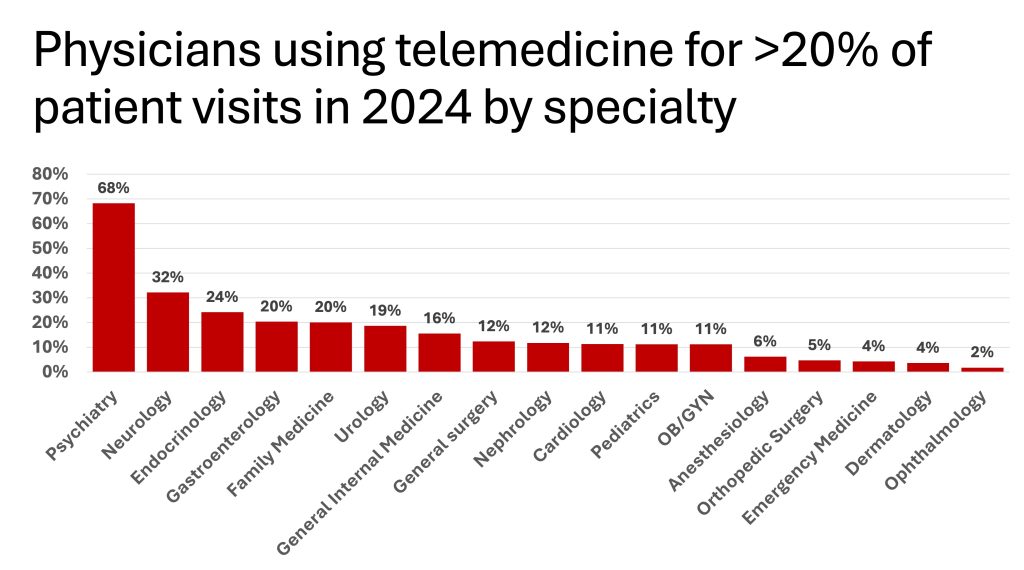
On the surface, it may seem surprising that telemedicine is utilized as much as it is in gastroenterology (20% using telemedicine for more than 20% of encounters), urology (19% using telemedicine for more than 20% of encounters), and general surgery (12% using telemedicine for more than 20% of encounters). However, these procedure-based specialties often schedule post-procedure follow-up encounters to discuss pathology results with patients and these encounters primarily consist of counseling which lends itself very well to telemedicine. In addition, many post-surgical follow-up visits are bundled into the procedure code for the initial surgery and are thus not reimbursed separately. These post-op visits are often used primarily for symptom reporting which can be done by audio telemedicine or simple examination of an incision which can be done by video telemedicine.
Telemedicine encounter complexity
Early in the pandemic, both primary care physicians and specialty physicians mostly billed low-complexity encounters for telemedicine. A study from a New York City health system found that primary care physicians billed low complexity E/M codes for most of their new and return telemedicine encounters. On the other hand, as the pandemic progressed, specialty physicians billed moderate complexity E/M codes for most of their new and return telemedicine encounters. Primary care physicians rarely billed high complexity telemedicine E/M codes but specialists billed a significant number of telemedicine encounters as high complexity (albeit fewer than moderate or low complexity).
So, what should physicians do now?
Unless Congress passes new legislation in the next month, telemedicine will no longer be covered by traditional Medicare for most Americans who are not living in rural parts of the country with access to a local rural health facility that participates in telemedicine with physicians located elsewhere. Behavioral health telemedicine will continue to be covered as this was made permanent by Congressional legislation in 2021 (of note, behavioral health patients must have an initial new patient in-person visit and an annual return in-person visit). Given the popularity of telemedicine, particularly among those with disability, mobility, and transportation limitations, it is hopeful that Congress will pass new legislation to extend traditional Medicare coverage for telemedicine or make telemedicine coverage permanent. Even if Congress fails to pass an extension, many Medicare Advantage Plans (Medicare Part C) may continue to cover telemedicine since these plans are administered by commercial insurance companies that have the freedom to cover or not cover telemedicine at their own discretion. Similarly, state-specific Medicaid plans and regular commercial health insurance plans may elect to continue telemedicine coverage for their enrollees.
This could result in a patchwork of telemedicine coverage with some patients within a medical practice being eligible for telemedicine coverage and others not eligible. Physician practices will then need to decide if they will offer telemedicine to those patients who do have insurance telemedicine benefits. This would require schedulers to determine whether or not each individual patient is eligible for telemedicine based on their specific health insurance coverage. Some practices may find that it is simpler to just not offer telemedicine to any patients rather than risk denials of bills for telemedicine encounters if a particular patient’s insurance plan no longer covers telemedicine after January 30, 2026.
Even if Congress lets Medicare telemedicine coverage expire in January 2026, patients in certain rural areas will still be eligible for telemedicine coverage based on the pre-pandemic telemedicine rules. However, these rural patients would now be required to go to a local rural health facility for their telemedicine encounter instead of having the telemedicine encounter in their own home. In addition, telemedicine could still be used for post-procedure and post-surgical follow-up encounters when those encounters are bundled into the procedure CPT code and not billed separately.
For now, physicians should not schedule telemedicine encounters for patients with traditional Medicare beyond January 30, 2026. Patients with Medicare Advantage Plans, with state-specific Medicaid plans, and with commercial health insurance policies should be scheduled on an individual basis, depending on whether or not their specific insurance carrier has agreed to continue telemedicine coverage after the telemedicine provisions for traditional Medicare expire. Uninsured patients can continue to be scheduled for telemedicine encounters since these patients pay out of pocket (or do not pay at all) and are thus not subject to Medicare telemedicine coverage rules. Post-procedure telemedicine encounters can continue to be scheduled for all patients if those encounters are bundled into the procedure CPT code, unless the specific code dictates that an in-person post-procedure visit is mandated. Neurologists and endocrinologists will be particularly impacted since these specialties have the greatest penetrance of telemedicine in their practices.
All physicians who use telemedicine should advocate for Congress to make Medicare telemedicine coverage permanent since telemedicine has become particularly beneficial for patients who are disabled and who otherwise have mobility and transportation barriers to in-person office visits.
December 27, 2025
